TIN and branch code
Stored the way your team writes it, when the schema wants nine digits and a separate branch field.

| What NetSuite does | What EIS requires, and your NetSuite doesn’t do |
|---|---|
| BIR-shaped invoice templates via the Philippines Localization SuiteApp | A v2.01 structured JSON payload, built per document |
| Correct statutory fields on the printed document | A 24-character EisUniqueId keyed to your EIS-Cert ID |
| Your books, your subledger, your close | JWS signing under your tax certificate, then encryption |
| Reports and audit trail | Authenticated transmission on a six-hour token, within three calendar days |
| — | Real-time status back from the BIR, with rejections surfaced and resolved before day four |
| — | Ten-year retention of JSON, signatures, and BIR acknowledgements |
Most EIS providers can connect to the BIR. Far fewer have seen a NetSuite account before. That is where compliance projects run late — and it is the only thing we work on.
Stored the way your team writes it, when the schema wants nine digits and a separate branch field.
That must resolve to exactly 0.00 VAT on exempt and zero-rated documents.
Resolving into line-level regular and special discount fields.
Correctly referencing the documents they correct — where most retrofits fail their first sandbox run.
Where everything has to transmit in Philippine pesos.
The Program
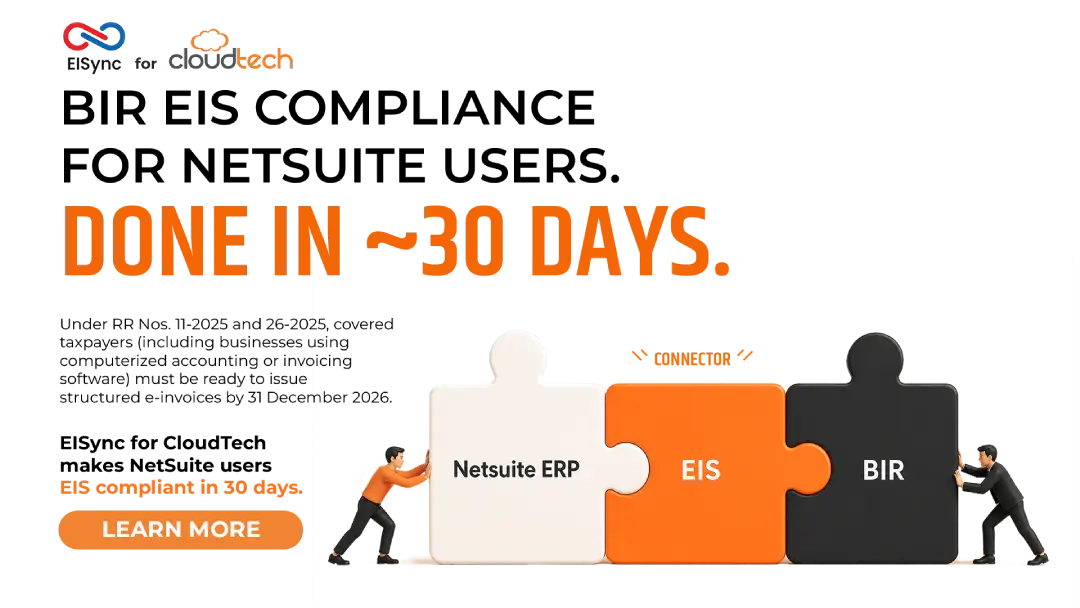
EISync for NetSuite brings compliance into your environment in four stages, each with a deliverable you can hold us to. Your NetSuite is not replaced, re-implemented, or upgraded to do this — EISync sits alongside it.
Covered-category confirmation, then your NetSuite invoice fields mapped to the BIR JSON structure: TINs, branch codes, SuiteTax classifications, discount logic, memo referencing.
Deliverable: Field mapping and a dated gap register.
EISync for NetSuite configured against your account — automated JSON conversion, EIS Unique ID per transaction, VAT / VAT-exempt / zero-rated classification, plus cancellations, returns and price adjustments.
Deliverable: BIR-ready payload generation from your live data.
Sandbox environment: authentication API, callback configuration, encryption and JWS signing verified, BIR test cases passed, then UAT with your finance team.
Deliverable: Passing sandbox and signed-off UAT.
EIS Certificate application, Permit to Transmit, automated scheduled submissions, cutover.
Deliverable: Live transmission under your PTT.
The Cost of Waiting
Section 264-A of the Tax Code penalizes failure to transmit sales data at one-tenth of one percent of annual net income for the second preceding taxable year, per day of violation, or ₱10,000 per day — whichever is higher. Where violations aggregate beyond 180 days in a taxable year, the provision reaches permanent closure.
Section 264 separately covers issuance violations at ₱1,000 to ₱50,000, with imprisonment of two to four years in the criminal provision.
And there is a step before the deadline: certification and your Permit to Transmit run at the BIR’s pace, in a queue that gets longer every week. Our part takes 30 days. The queue is the part nobody controls — which is why we recommend starting by 30 September, and why November 30 is the last start date that works at all.

Large Taxpayer status is one covered category. CAS and CBA users are another, with no revenue threshold. If you registered NetSuite as your computerized accounting system, that is the category to check first. Confirm your specific position with your tax adviser.
Yes — because almost none of it is invention. EISync already exists, already converts ERP data to BIR-standard JSON, already signs and transmits. We map your NetSuite to it, configuring it against your account, validating in sandbox, and getting your Permit to Transmit. What we cannot compress is the BIR’s own turnaround on that permit — which is exactly why starting in September or October matters more than starting at all in December.
They may be cheaper on the integration, and the integration is the easy part. The work that remains either way is the NetSuite side — field mapping, tax classification, discount and memo logic, reconciliation to your subledger. That is where the time goes. The difference is that we bring both halves from one group: EISync for the BIR side, and consultants who work only in NetSuite for yours.
Then ask them for two things: your EIS-Cert ID, and your sandbox validation results. If they have both, you are in good shape and you do not need us — we will say so on the call. If they cannot produce either, that is worth knowing in September rather than December.
We will confirm which covered category applies to you, walk the specific gaps in your NetSuite account, and give you a dated plan you can take to your CFO. If your current setup is already handled, we will tell you and end the call early.