
CloudTech LAUNCHPAD · Professional Services
No Stock or Warehouse? You Still Have Inventory: Your Billable Hours
Philippine services firms were told they don't need ERP because they don't carry stock. In fact they carry the most perishable inventory in business.
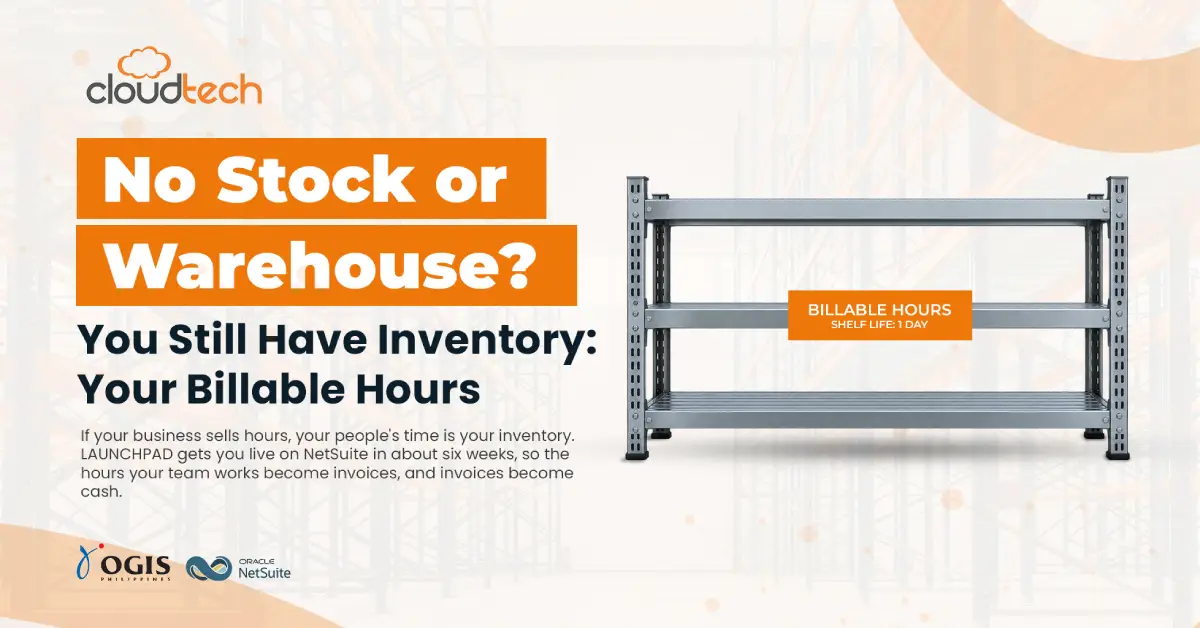
Walk into almost any ERP pitch in Manila and you can guess the slides. A warehouse. A forklift. A barcode scanner. Stock levels by SKU, reorder points, landed cost.
If you run an architecture practice, a BPO, a law firm or a clinic, you sit through that and reach a reasonable conclusion: this isn't for us. We don't have a warehouse. We don't count boxes. We have people, and our accounting software plus a few good spreadsheets keep them paid and our clients billed.
That conclusion is understandable. It is also costing services firms more than they realise, because it rests on a false premise. Services firms do carry inventory. They carry the most perishable inventory there is.
The inventory nobody counts
A distributor's stock can sit on a shelf for a month and still be sold. A manufacturer's finished goods can wait in a warehouse until a buyer appears. Their inventory has a shelf life.
A services firm's inventory is time: the hours its engineers, consultants, designers, lawyers, agents, nurses and deployed staff put in. That inventory expires every day. An hour worked and never recorded is gone. An hour recorded and never billed is gone. An invoice sent and never collected might as well be.
There is no stockroom where yesterday's unbilled hours wait to be sold tomorrow.
This matters at national scale. The Philippine IT-BPM industry alone ended 2025 with about US$40 billion in export revenue and roughly 1.9 million workers, according to IBPAP. Add the engineering and design firms, agencies, consultancies, law and accounting practices, clinics and manpower agencies, and a large part of the Philippine economy runs on hours. Yet most ERP conversations were never built around them.
Where the hours go: three leaks
Leaks in a services firm rarely look dramatic. Nobody walks off with a pallet. Value slips out quietly, in three places.
Leak 1: Capture
The work happened, but no record of it did. Timesheets get filled in on Friday afternoon, from memory. The 30-minute client call, the extra revision round, the weekend site visit, the overtime shift: none of it reaches a system. In a manpower agency, deployed hours sit in a spreadsheet that never quite matches payroll.
Leak 2: Convert
The work was recorded, but it didn't become an invoice, or became one late. Billing waits for month-end because someone has to pull data from three files. Retainers quietly absorb work outside their scope. Engineering milestones are finished weeks before anyone bills them. Every day between work done and invoice sent is a day you are financing your client.
Leak 3: Collect
The invoice went out, but the cash didn't come back on time. The receivables aging report lives in one person's head, or on one person's laptop. Follow-ups happen over Viber. Nobody can say, without a day of digging, which clients always pay late, or how much of this month's payroll is sitting in someone else's bank account. For a clinic it is HMO receivables; for an agency, the client who always needs "one more approval".
And the blind spot. Behind all three sits a bigger question most services firms can't answer quickly: which clients, projects and service lines actually make money? When your largest cost is people, profit lives in the gap between hours paid and hours billed. Without one system connecting the two, the answer arrives at year-end, if it arrives at all.
Why spreadsheets hold out longer in services
Distributors usually outgrow spreadsheets early because stock forces the issue: 500 missing units are hard to hide. Services firms can run on spreadsheets for years because their losses are invisible. A spreadsheet can't show you the hours that never entered it.
The setup that works at 20 people strains at 80 and breaks at 200. More clients bring more billing arrangements: retainers, fixed fees, time and materials, milestones, HMO accreditations, per-deployment rates. Each one adds a tab, a formula and a person whose job is mostly reconciliation.
Then there is compliance. The BIR's electronic invoicing (EIS) and computerized accounting (CAS) requirements put more weight on the records behind every invoice. Firms that bill by hand feel that pressure first.
The most expensive answer is "not yet"
Most services leaders already know their setup is stretched. What stops them is the size of the decision. ERP sounds like a big project, and there is always a busy season to get through first.
For some firms, a full-scope implementation from day one is exactly the right call, and it is work CloudTech does every year. But "not yet" has a cost of its own, and a services firm pays it in the same perishable currency. Every month spent waiting is another month of hours slipping through the same three leaks.
That is the gap CloudTech LAUNCHPAD was built for.
A different starting point
LAUNCHPAD is CloudTech's phased way to start on Oracle NetSuite. You begin with a pre-built Foundation phase that takes core financials live in about six weeks, with as few as three to five users. Then you add capability in phases, as the business is ready.
For a services firm, the phases line up with the leaks:
Foundation, in about six weeks
One set of books in the cloud. Billing and receivables in one system, with revenue and cost visible by client, department and service line. BIR EIS, BIR CAS and SOX roles built in, not bolted on. This closes the leaks closest to cash first: Convert and Collect.
Expansion
Added modules, workflows and customizations, such as project and time tracking to close the Capture leak, and the billing rules your contracts need.
Scale
Integrations with third-party systems such as payroll and HR, additional companies, and more workflows as you grow.
Because investment is spread across phases, the upfront commitment is lower, and the return can start as soon as Phase 1 is live. LAUNCHPAD is built for the Philippine mid-market and delivered by CloudTech, the Oracle NetSuite business unit of OGIS Philippines.
Seven questions to ask about your own firm
If you can't answer most of these in ten minutes, your hours are leaking somewhere.
- How many hours did your team work last month, and how many did you bill?
- How long after the work is done does the invoice go out?
- Which five clients take longest to pay, and how much do they owe you today?
- Which client or service line was most profitable last quarter? Which was least?
- How many days does your month-end close take?
- How many spreadsheets does it take to produce one invoice?
- If the BIR asked for the records behind last month's invoices, how long would it take to pull them together?
Find your leaks before they cost another month
The free LAUNCHPAD Assessment is a 45-minute session with CloudTech's Pre-Sales team. You leave with a map of where your hours leak, a read on whether LAUNCHPAD's Foundation phase fits your firm, and a phased roadmap you can take to your partners or board.
Your inventory expires every day. Start counting it.
Get your free LAUNCHPAD Assessment